Difference Between NSE and BSE: 10 Key Differences Every Indian Trader Should Know
You open your trading platform, see Nifty moving sharply, and then notice Sensex on another screen. Both represent India’s stock market, so a common question comes up: what is the difference between NSE and BSE?
The answer goes beyond two different stock exchanges. NSE and BSE differ in their benchmark indices, trading activity, market history, listed securities, and the way traders commonly use them. For an active trader, understanding these differences helps you choose the right index, read market data correctly, and avoid confusion when placing orders.
Understanding the Difference Between NSE and BSE is especially useful for beginners because it explains why Nifty 50 and Sensex are tracked differently.
What Is the Difference Between NSE and BSE?
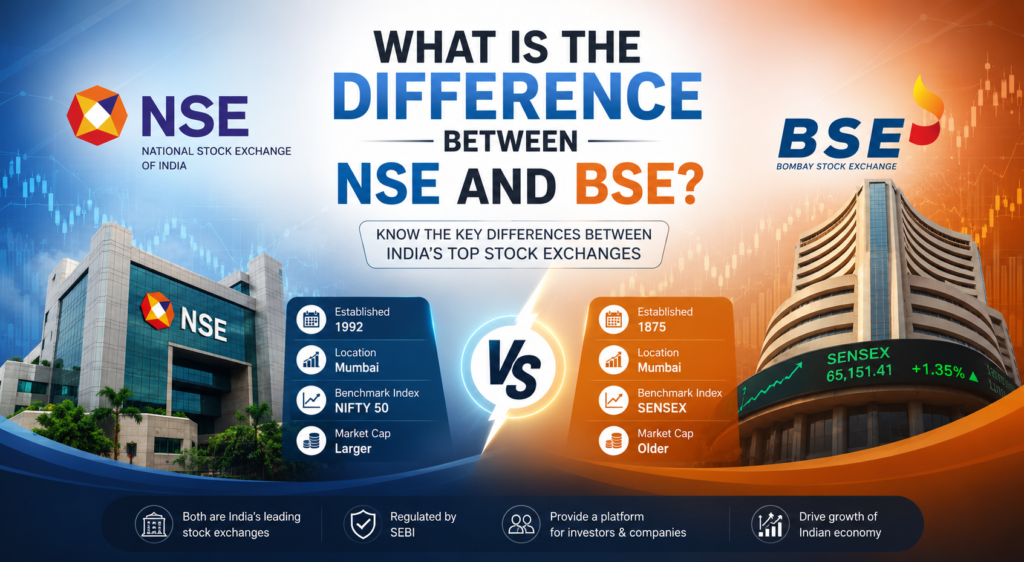
For new investors, understanding the Difference Between NSE and BSE makes it easier to identify where a stock or index is traded.
The National Stock Exchange (NSE) and Bombay Stock Exchange (BSE) are two major stock exchanges in India.
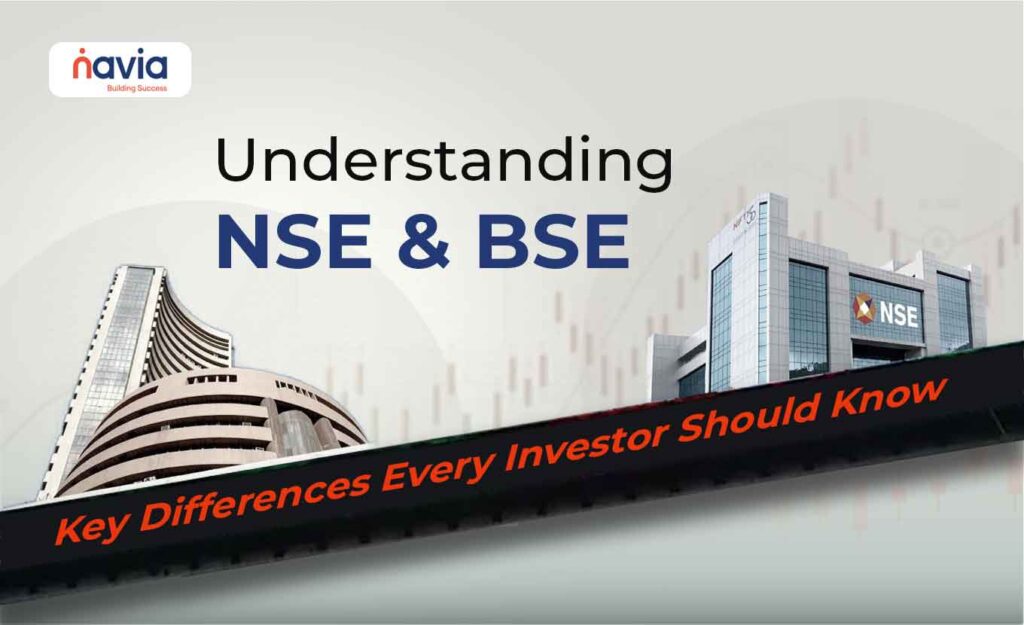
The NSE is best known for the Nifty 50, while BSE is best known for the Sensex.
Both exchanges provide a marketplace where buyers and sellers can trade securities such as:
- 📈 Equity shares
- 📊 Exchange-traded funds
- 💰 Bonds and other securities
- 📉 Derivatives
- 📌 Index-based products
The biggest practical difference for many traders is liquidity and trading activity.
NSE generally sees heavier trading activity in many actively traded stocks and derivatives. BSE, meanwhile, has a much longer history and has thousands of securities listed on its exchange.
One of the easiest ways to understand the Difference Between NSE and BSE is to compare their most widely followed benchmark indices.
A Simple Example
Suppose you want to trade a large Indian company such as Reliance Industries.
The company can have shares listed on both NSE and BSE. The underlying company is the same, but the exchange through which your order is executed can be different.
If NSE has heavier trading activity for that stock, you may see more active order flow there.
💡 Pro Tip: Don’t assume that NSE and BSE are two different companies just because their prices can differ slightly. They are two separate exchanges where the same security can often be traded.
NSE vs BSE: Quick Comparison
| Feature | NSE | BSE |
|---|---|---|
| Full Name | National Stock Exchange | Bombay Stock Exchange |
| Established | 1992 | 1875 |
| Main Benchmark | Nifty 50 | Sensex |
| Trading Technology | Electronic | Electronic |
| Popular With | Active traders and derivatives traders | Equity investors and long-term investors |
| Major Index | Nifty 50 | Sensex |
| Market Type | Stock exchange | Stock exchange |
| Location | Mumbai | Mumbai |
| Major Strength | High trading activity and derivatives | Long history and broad listing base |
The important point is that both exchanges serve the Indian securities market, but traders often use them differently.
NSE: What Traders Should Know
The National Stock Exchange of India began operations in the 1990s and quickly became a major electronic trading platform.
For active traders, NSE is particularly important because of its highly traded derivatives market.
The Nifty 50 is a diversified 50-stock index covering 13 sectors and is used for benchmarking, index funds and index-based derivatives.
If you trade index futures or options, Nifty is likely to be one of the first instruments you study.
This Difference Between NSE and BSE comparison also shows why traders may prefer one exchange depending on liquidity and the type of security they trade.
Why Active Traders Watch NSE
📈 High activity in popular stocks
📊 Strong derivatives participation
⚡ Fast price movement during major market events
📌 Nifty 50 provides a widely followed market benchmark
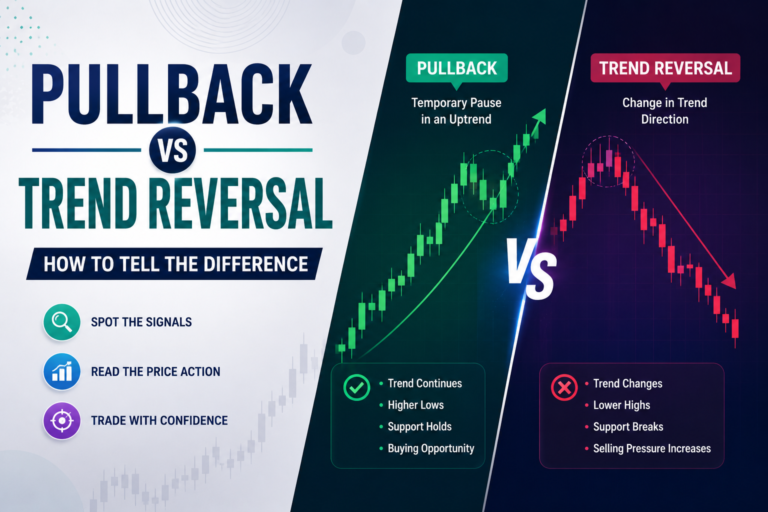
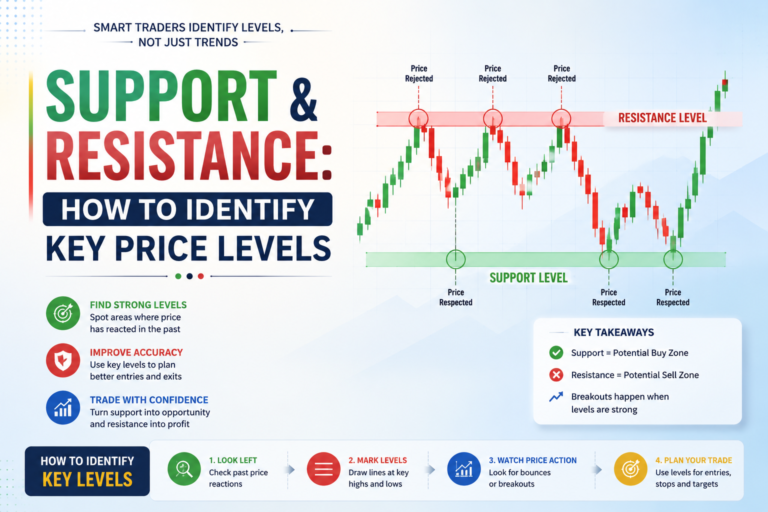
For example, when Nifty breaks an important resistance level with strong volume, traders may look for confirmation from broader market conditions before entering.
That does not mean every breakout is a buying opportunity.
A breakout without participation can quickly turn into a false breakout.
You can also check the Nifty 50 live chart to study price structure, historical movement and technical conditions before making a trading decision.
BSE: What Traders Should Know

The Bombay Stock Exchange, commonly known as BSE, is one of the oldest stock exchanges in Asia.
Its best-known benchmark is the Sensex, which tracks 30 major companies.
BSE has an enormous historical footprint in India’s capital markets and provides a platform for trading a broad range of securities.
Why BSE Still Matters
📌 Sensex is one of India’s most recognized market indicators.
📊 BSE has a large number of listed securities.
💼 Investors can access companies across different sectors and market capitalizations.
For a long-term investor researching Indian companies, BSE data can be useful even if the actual trading activity in a particular stock is stronger on NSE.
Nifty 50 vs Sensex: What’s the Difference?
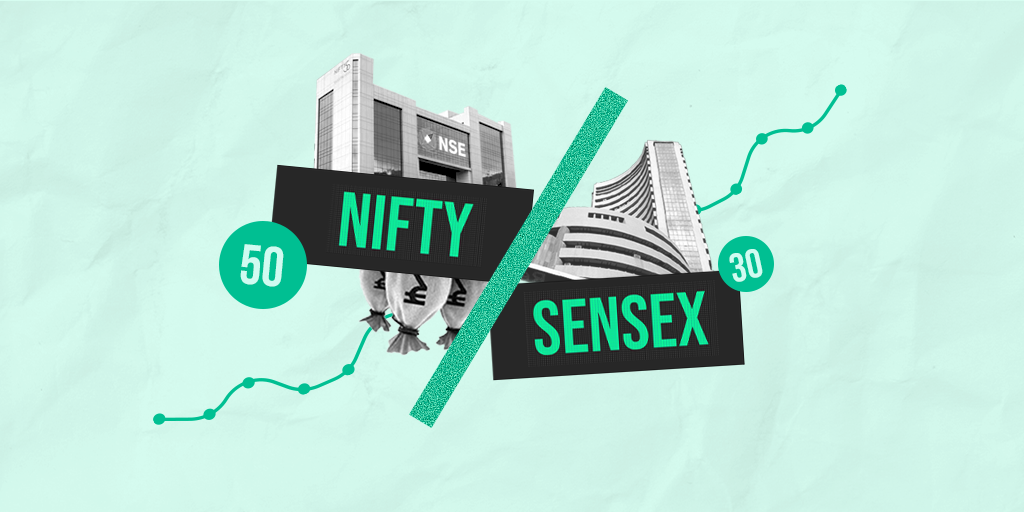
A simple way to understand the Difference Between NSE and BSE is to look at Nifty 50 and Sensex side by side.
This is where many beginners get confused.
Nifty 50 belongs to NSE.
Sensex belongs to BSE.
They are both benchmark indices, but they track different baskets of companies.
| Factor | Nifty 50 | Sensex |
| Exchange | NSE | BSE |
| Number of Companies | 50 | 30 |
| Common Use | Trading and market analysis | Market benchmark and investing |
| Benchmark Type | Broad large-cap index | Large-cap index |
| Popular Derivatives | Yes | Yes |
Example
Imagine the market opens strongly after positive global news.
You may see:
Nifty 50: +1.0%
Sensex: +0.9%
This doesn’t mean one exchange is performing badly.
The two indices contain different companies and use different index methodologies.
Their movements can therefore differ slightly.
NSE and BSE Share Prices: Why Can They Be Different?
Here’s a practical question traders often ask:
“If Reliance is the same company, why can its NSE and BSE prices be slightly different?”
The reason is market mechanics.
The price on each exchange is determined by its own order book.
Suppose:
- NSE buyer is willing to pay ₹2,500
- NSE seller wants ₹2,501
- BSE buyer is willing to pay ₹2,499
- BSE seller wants ₹2,502
The prices aren’t necessarily identical at every second.
Arbitrage activity can reduce large price differences, but small differences can still appear because of liquidity, order flow, timing, and transaction costs.
📌 For normal traders, don’t obsess over tiny price differences. Focus on liquidity, spreads, execution quality, and the exchange supported by your trading strategy.
Another important part of the Difference Between NSE and BSE is how order books, liquidity and trading activity can affect prices at a particular moment.
How Traders Should Choose Between NSE and BSE
You don’t necessarily have to pick one exchange for everything.
Your choice should depend on what you’re trading.
Once you understand the Difference Between NSE and BSE, choosing where to trade becomes more straightforward.
The Difference Between NSE and BSE also matters when comparing liquidity, spreads and order execution.
Step 1: Identify Your Instrument
If you’re trading Nifty 50, you’re dealing with an NSE benchmark.
If you’re analysing Sensex, you’re looking at the BSE benchmark.
For individual stocks, check where the stock has stronger trading activity and better execution conditions.
Step 2: Check Liquidity
Liquidity matters because you want to enter and exit positions without unnecessary slippage.
Look at:
- Trading volume
- Bid-ask spread
- Order-book depth
- Average daily turnover
For active trading, higher liquidity is usually preferable.
Step 3: Confirm the Market Trend
Don’t analyse an individual stock in isolation.
Check:
- Nifty/Sensex direction
- Sector trend
- Volume
- Market breadth
- Higher-timeframe structure
A stock showing a bullish breakout while the broader market is strongly bearish deserves extra caution.
Step 4: Use Technical Confirmation
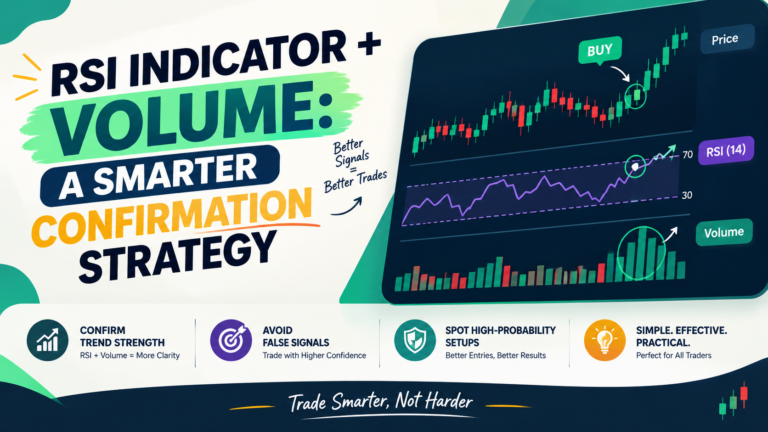
If you’re new to RSI, learn how the RSI indicator works and how traders use overbought and oversold levels before adding it to your strategy.
TradingView can help you analyse price structure, moving averages, RSI and volume before making a decision.
A simple setup could include:
20 EMA + 50 EMA + RSI + Volume
For example:
- Price above 20 EMA
- 20 EMA above 50 EMA
- RSI above 50
- Breakout accompanied by stronger volume
This combination doesn’t guarantee a profitable trade. It simply gives you a structured way to evaluate market conditions.
A properly structured trading plan can also help you define which instruments to trade, when to enter, where to place your stop-loss, and when to exit.
Entry, Stop-Loss and Take-Profit Rules
A trader shouldn’t enter simply because a stock is moving.
Define the trade before clicking the buy button.
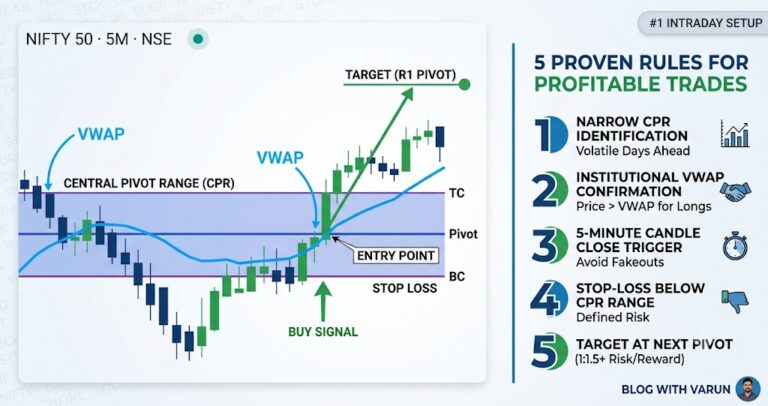
Suppose a stock breaks resistance at ₹1,000.
You identify:
- Entry = ₹1,005
- Stop-loss = ₹985
- Target = ₹1,045
Your risk is:
₹1,005 − ₹985 = ₹20 per share
Your potential reward is:
₹1,045 − ₹1,005 = ₹40 per share
So:
Risk-Reward Ratio = ₹40 ÷ ₹20 = 2:1
That means you’re risking ₹1 to potentially make ₹2.
Understanding the risk-reward ratio in trading can help you decide whether a potential setup is worth taking before you risk your capital.
📊 Trading Decision Table
| Area | Rule |
| Entry | Wait for breakout and confirmation |
| Volume | Prefer stronger volume during breakout |
| Stop-Loss | Place below logical market structure |
| Target | Define before entering |
| Risk | Keep position size controlled |
| Exit | Follow the predefined plan |
| Re-entry | Only after a fresh setup |
This approach is more useful than randomly moving your stop-loss after entering.
3 Common Mistakes Retail Traders Make
⚠️ Mistake #1: Confusing NSE With Nifty and BSE With Sensex
NSE and BSE are exchanges.
Nifty 50 and Sensex are indices.
They are not interchangeable terms.
Think of it like this:
NSE → Nifty 50
BSE → Sensex
That’s the basic relationship beginners should remember.
⚠️ Mistake #2: Ignoring Liquidity
A stock can look attractive on a chart but still be difficult to trade efficiently if liquidity is poor.
Before entering, check:
- Spread
- Volume
- Market depth
- Recent trading activity
This becomes even more important for short-term traders.
A few points of slippage can significantly affect a scalping strategy.
⚠️ Mistake #3: Looking Only at One Timeframe
A 5-minute chart can show a bullish breakout while the daily chart is sitting directly below major resistance.
That’s a warning.
A better workflow is:
Daily → 1 Hour → 15 Minute → Entry Timeframe
This gives you context before execution.
For example, if the daily trend is bullish and the 15-minute chart produces a clean breakout with strong volume, the setup has better context than a random breakout on a 5-minute chart.
NSE vs BSE for Beginners: Which Is Better?
There isn’t one universal winner.
For an active trader, NSE is often the first exchange to study because of its strong trading activity and importance in index derivatives.
For investors, BSE remains highly relevant because of its long history, broad listed-company base, and the importance of the Sensex.
The right question isn’t:
“Which exchange is better?”
Ask:
“Which exchange provides the liquidity, instrument and execution conditions my strategy needs?”
Choosing the right exchange is only one part of becoming a disciplined trader; controlling emotions while trading is equally important when markets move quickly.
That’s a much better trading question.
For beginners, learning the Difference Between NSE and BSE is a useful first step before moving into stock selection and technical analysis.
TradingView Setup for NSE and BSE Analysis
A clean chart can make your decision-making easier.
You can use TradingView to monitor:
📈 Price structure
📊 Volume
📉 RSI
📌 Moving averages
🎯 Support and resistance
For example, create a watchlist containing:
- Nifty 50
- Sensex
- Bank Nifty
- Your selected stocks
- Relevant sector indices
Then compare individual stocks against the broader market.
Free vs Advanced Charting
| Feature | Free Setup | Advanced Setup |
| Basic charts | ✅ | ✅ |
| Indicators | Limited | More options |
| Multiple layouts | Limited | More flexible |
| Alerts | Limited | Advanced |
| Multiple charts | Limited | Better multi-chart workflow |
| Best For | Beginners | Active traders |
You don’t need an expensive setup to become a better trader.
A clean chart, proper risk management and disciplined execution matter more than having ten indicators on your screen.
Final Thought
The difference between NSE and BSE becomes simple once you separate the exchanges from their benchmark indices: NSE is associated with Nifty 50, while BSE is associated with Sensex. For trading, pay attention to liquidity, spreads, volume and execution instead of choosing an exchange simply because it is popular. Before risking live capital, paper-trade your setup, test your entry and exit rules, and keep your risk small.