AI Agentic Trading: How AI Agents Are Changing Retail Trading (And What You Need to Know Before You Hand Over the Keys)
In 2023, a hedge fund quant told me something that stuck: “The edge isn’t in having a faster algorithm anymore. It’s in having an algorithm that doesn’t need you to babysit it.” That single sentence describes the entire shift happening in retail trading right now — and most retail traders haven’t caught up to it yet.
If you’ve spent any time on trading Twitter or fintech forums in the last year, you’ve seen the term “AI agentic trading” thrown around like it’s the second coming of algorithmic trading. Some of the hype is real. Most of it is noise. And buried underneath both is a genuinely important shift in how retail traders can operate — if you understand what these systems actually do, and more importantly, what they don’t.
This post cuts through the noise. You’ll walk away understanding what AI agentic trading actually is, how it’s different from the trading bots and robo-advisors you’ve heard of before, a practical framework for evaluating whether it fits your own trading, and the risks nobody’s advertising on the landing pages.
Table of Contents
- What Is AI Agentic Trading, Really?
- How Is This Different from Old-School Trading Bots?
- What Are AI Trading Agents Actually Doing in the Market Today?
- Why Are Retail Traders Suddenly Getting Access to This?
- A Practical Framework: Should You Use an AI Trading Agent?
- What Are the Real Risks Nobody Talks About?
- How Do You Get Started Safely?
- Key Takeaways
- FAQ
What Is AI Agentic Trading, Really?
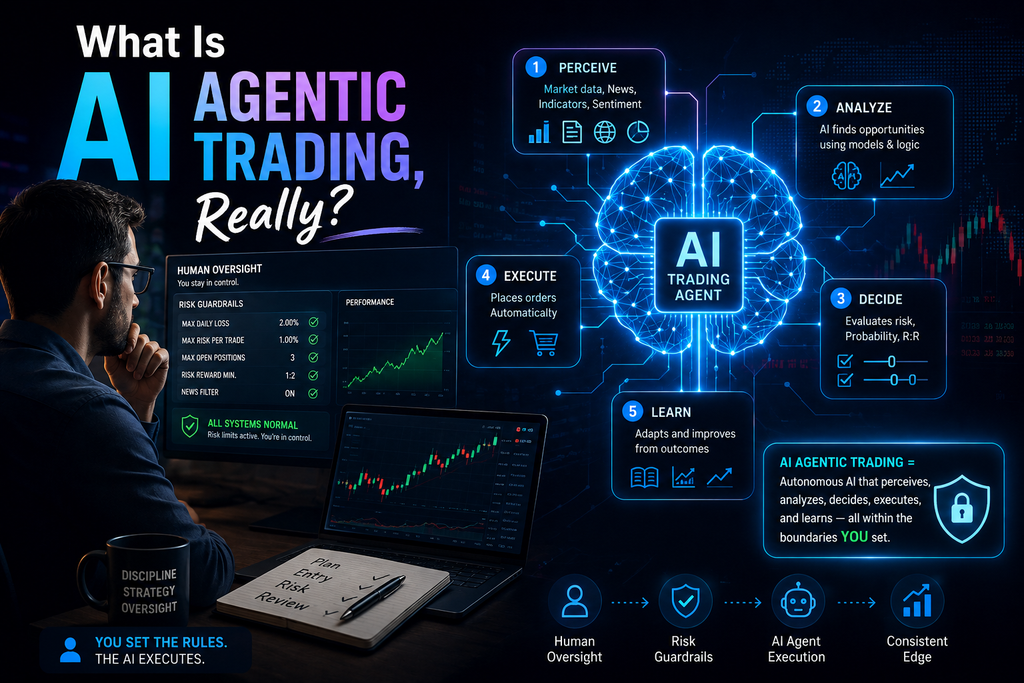
Let’s define terms before we go further, because this space is drowning in vague marketing language.
AI agentic trading refers to trading systems where an AI model doesn’t just generate a signal — it perceives market data, makes a decision, executes the trade, and monitors the outcome, often adjusting its own approach along the way, with minimal human intervention at each step.
The key word is agentic — meaning the AI has a degree of autonomy to take multi-step actions toward a goal, not just answer a single question or produce a single output.
Compare that to what most retail traders are used to:
- A trading signal service tells you “buy NIFTY calls here.” You decide whether to act.
- A robo-advisor rebalances a portfolio on a fixed schedule based on a static risk model.
- An AI agent can scan news, check your portfolio exposure, size a position based on your risk parameters, place the order, set a stop-loss, and then re-evaluate the thesis an hour later — all without you clicking anything after setup.
That last part — the chaining of perception, decision, and action, in a loop, with memory of what it just did — is what makes it “agentic” rather than just “automated.”
How Is This Different from Old-School Trading Bots?
Retail traders aren’t new to automation. Expert Advisors (EAs) on MetaTrader, simple momentum bots, and options screeners have existed for over a decade. So what’s actually new here?
1. Old bots follow rules. AI agents interpret context. A traditional bot might say: “If RSI < 30 and price crosses above 20-day SMA, buy.” An AI agent can read an earnings call transcript, a Fed statement, or a geopolitical headline and reason about how that context should change the rule itself — in plain language, not pre-coded conditionals.
2. Old bots are static until reprogrammed. AI agents can adapt within guardrails. This doesn’t mean they’re smarter than a human discretionary trader — they’re not, and I’ll get to why that matters. But they can adjust position sizing or pause activity based on changing volatility regimes without a developer manually updating the code each time.
3. Old bots need you to define every scenario. AI agents can handle open-ended instructions. You can tell an AI agent something like “protect this portfolio’s downside if VIX spikes above 25, but stay invested for the AI theme,” and it will translate that fuzzy instruction into concrete actions. A rules-based EA simply can’t do that — it needs if/then logic spelled out in advance.
Here’s a simple comparison to make this concrete:
| Feature | Traditional Trading Bot | Robo-Advisor | AI Agentic Trading System |
|---|---|---|---|
| Decision logic | Fixed rules (if/then) | Static risk model | Dynamic, context-aware reasoning |
| Adapts to new information | No (needs recoding) | Rarely (periodic rebalance) | Yes, within set guardrails |
| Executes trades autonomously | Yes | Usually no (advisory) | Yes |
| Understands unstructured data (news, filings) | No | No | Yes |
| Explains its own reasoning | No | No | Often yes (if designed well) |
| Requires constant supervision | Low, but rigid | Very low | Medium — different kind of supervision |
What Does AI Agentic Trading Actually Do in the Market Today?”
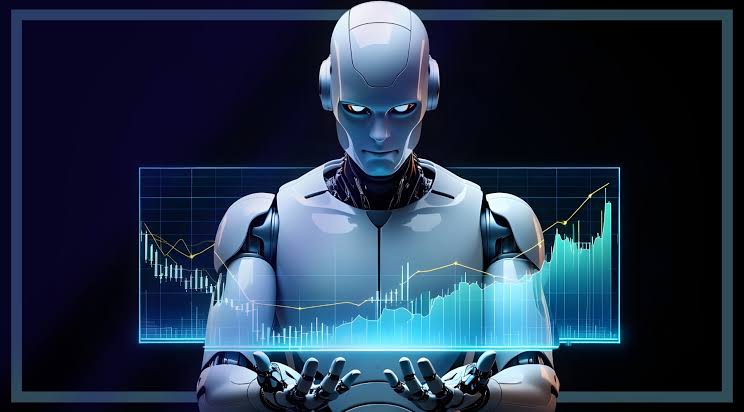
From what’s visible in live markets and public product rollouts, agentic AI is currently being used for a handful of concrete tasks — not “predicting the market,” which is still the wrong framing.
- Research synthesis: Digesting earnings calls, 10-Ks, and news flow into a digestible thesis in seconds instead of hours.
- Execution optimization: Slicing large orders to minimize market impact (this is the oldest and most proven use case — institutional desks have used execution algorithms for 20+ years).
- Portfolio monitoring: Flagging when your exposure drifts from your stated risk tolerance and proposing rebalancing trades.
- Sentiment and event scanning: Watching for headline risk across hundreds of tickers simultaneously — something no human can do manually.
- Strategy backtesting and iteration: Agents that can propose a strategy, test it against historical data, and refine parameters faster than a solo retail quant could by hand.
What they are not reliably doing yet, despite marketing claims: consistently outperforming the market with genuine edge, understanding true tail-risk events they haven’t seen before, or replacing your judgment on illiquid or thinly-traded instruments where execution quality depends on nuanced reads of order flow.
From years of watching order flow, I can tell you the market doesn’t reward “automation” by itself — it rewards edge, and edge is still scarce. An AI agent that trades faster but with no real informational or structural advantage is just automating your losses faster too.
Why Are Retail Traders Suddenly Getting Access to This?
Three things converged to make this available to individuals rather than just hedge funds:
- Large language models became good at reasoning over unstructured data — reading a news article and forming a coherent view — which used to require a human analyst.
- Brokerage APIs matured, meaning software can now place real orders programmatically at retail brokers, not just simulate them.
- Compute costs dropped enough that running an AI agent continuously no longer requires an institutional budget.
SEC — Investor.gov page on Automated Investment Tools
This is genuinely democratizing in one narrow sense: capabilities that used to sit only on a hedge fund’s desk (constant monitoring, rapid synthesis of huge information flows) are now accessible to a trader with a laptop. But — and this is important — access to the tool is not the same as access to the edge. Hedge funds still have data advantages, execution speed advantages, and capital advantages that no retail AI agent closes.
A Practical Framework: Should You Use an AI Trading Agent?
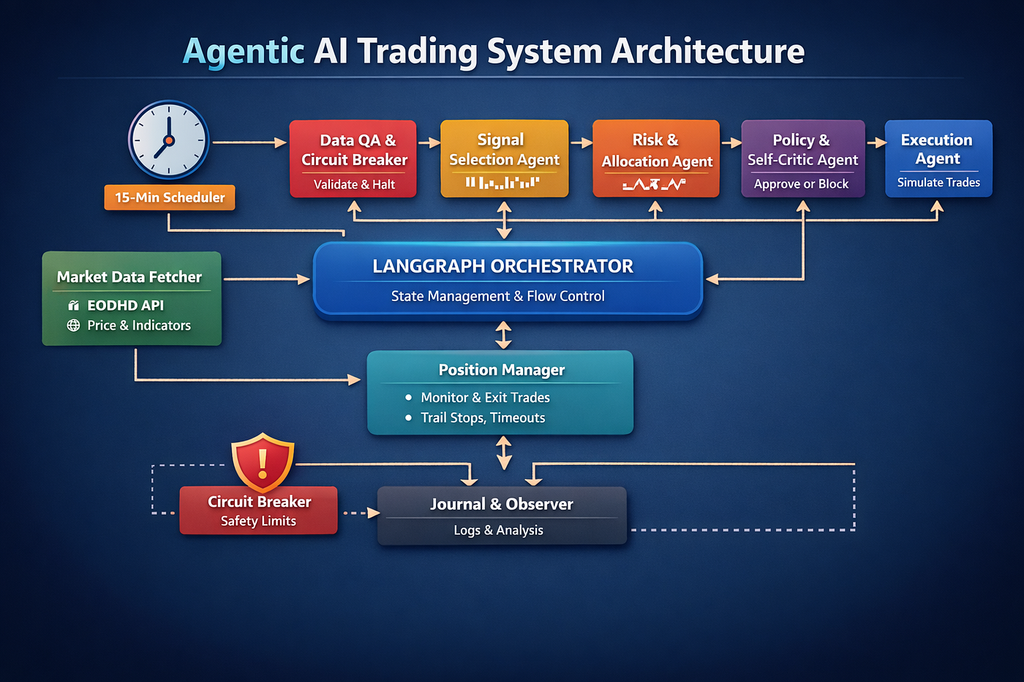
Before you plug your brokerage account into any AI agent, run it through this five-question filter. I use a version of this myself before adopting any new tool in a live trading process.
Step 1: Define the job, not the hype. What specific, narrow task do you want this agent to do? “Make me money” is not a job description. “Flag when any stock in my watchlist moves 5%+ on above-average volume” is.
Step 2: Check if it operates within hard guardrails. Does it have:
- A maximum position size per trade?
- A maximum daily loss limit that halts activity?
- A clear kill switch you can trigger instantly?
If the answer to any of these is unclear, that’s a red flag, not a minor detail.
Step 3: Ask for the reasoning, not just the trade. A well-built agent should be able to explain why it made a decision in plain language. If it can’t, you’re flying blind, and you won’t learn anything from wins or losses — you’ll just be gambling with extra steps.
Step 4: Backtest and paper-trade before real capital. Run it on historical data and then in a simulated account for at least 4–6 weeks across different volatility regimes before committing real money. A strategy that looks great in a trending bull market can be devastating in a choppy, range-bound one.
Step 5: Size it like you’d size a new, unproven strategy — small. Even after paper trading, allocate a small percentage of your capital (many experienced traders start around 1–5%) until you’ve watched it operate through at least one full market cycle or significant volatility event.
CFA Institute — “What Can AI Do for Investment Portfolios? A Case Study”
What Are the Real Risks Nobody Talks About?
This is the section most AI trading platforms conveniently skip in their marketing.
- Model hallucination in a financial context: AI models can misread a headline, misinterpret a filing, or simply generate a confident but wrong conclusion. In trading, a confident wrong answer executed automatically is far more dangerous than a wrong answer in a chatbot.
- Overfitting to historical data: An agent that backtests beautifully may simply have found patterns that worked in the past by coincidence, not causation. This is one of the oldest traps in quant trading, and AI doesn’t make you immune to it — if anything, it makes overfitting easier to produce and harder to detect.
- Latency and slippage: Retail-grade infrastructure isn’t co-located next to exchange servers. By the time your agent decides and executes, institutional systems have often already moved the price.
- Regulatory and custody questions: Who’s liable if an autonomous agent makes a trade that violates a pattern-day-trading rule, or exceeds a margin limit? This area is still legally underdeveloped, especially for individual retail accounts.
- Correlated failure risk: If thousands of retail traders are running similar AI agents built on similar underlying models, they may all react to the same news the same way at the same time — potentially amplifying volatility rather than dampening it, a dynamic regulators are actively studying.
- False sense of security: This might be the biggest one. A tool that “sounds” intelligent and explains itself in fluent language can lull traders into trusting it more than a black-box rules-based bot they know they don’t fully understand.
None of this means avoid the technology. It means treat it the way you’d treat a very capable junior analyst — useful, fast, sometimes brilliant, but not infallible, and never left unsupervised with your capital.
CFA Institute — “AI in Asset Management: Tools, Applications, and Frontiers”
How Do You Get Started Safely?
If you want to experiment with AI agentic trading without exposing yourself unnecessarily, here’s a sequence that mirrors how professional desks vet new systems:
- Start with research-only agents — tools that summarize filings, news, and earnings calls but don’t execute trades. Get comfortable with how they reason before giving them any execution power.
- Move to alerting agents — systems that flag opportunities or risks but require you to manually approve execution.
- Test semi-autonomous execution in a paper account with strict position limits.
- Only then consider limited, guardrailed live execution with capital you’re fully prepared to lose.
- Review performance weekly, not just P&L, but decision quality — were the reasons sound even when the trade lost?
Key Takeaways
- AI agentic trading means AI systems that perceive, decide, and act in a loop — not just generate a single signal, unlike older trading bots or robo-advisors.
- The core innovation is context-aware, adaptive reasoning, not raw speed — speed advantages still belong to institutions.
- Proven current use cases include research synthesis, execution optimization, portfolio monitoring, and sentiment scanning — not guaranteed alpha generation.
- Access to the technology is not the same as access to genuine market edge — that gap hasn’t closed.
- Always demand guardrails: max position size, daily loss limits, and a kill switch, before letting any agent touch real capital.
- Paper-trade for 4–6 weeks minimum across varied market conditions before allocating real money, and size initial allocations small (1–5% of capital).
- Treat AI agents like a capable but fallible junior analyst — verify their reasoning, don’t just trust their output.
FAQ
Q1: Is AI agentic trading the same as algorithmic trading? Not exactly. Algorithmic trading follows pre-set rules. Agentic trading adds a layer of adaptive reasoning and multi-step autonomy on top — it can interpret unstructured information and adjust its own approach within limits, which classic algo trading can’t do.
Q2: Can retail traders actually get consistent returns using AI agents right now? There’s no reliable evidence that AI agents produce consistent outperformance for retail traders today. Their strongest proven value is efficiency (research, monitoring, execution) rather than predictive edge.
Q3: Is it safe to let an AI agent trade my account fully autonomously? Only with strict guardrails (max position size, daily loss limits, kill switches) and only after extensive paper trading. Full autonomy without limits is one of the riskiest ways to use this technology.
Q4: How is this different from a robo-advisor like the ones offered by major brokers? Robo-advisors rebalance a portfolio on a fixed schedule using a static risk model. AI agents can continuously monitor markets, interpret new information in real time, and take action dynamically — a fundamentally more active and less predictable process.
Q5: What markets are AI agentic trading tools currently best suited for? Highly liquid markets — large-cap equities, major forex pairs, and index derivatives — where execution is straightforward. They’re far less reliable in illiquid or thinly-traded instruments where nuanced order-flow reads matter.
Q6: Will AI agents replace discretionary retail traders? Unlikely in the near term. They’re better understood as force multipliers for research and monitoring, not replacements for judgment, risk management, and the accountability a human trader brings to their own capital.
The Bottom Line
AI agentic trading isn’t science fiction, and it isn’t a magic money machine either. It’s a genuine step up in what individual traders can automate — moving from rigid rule-following bots to systems that can reason, adapt, and act within limits you set. The traders who benefit from this shift won’t be the ones who hand over full control and hope for the best. They’ll be the ones who use these agents as a force multiplier for research and discipline, while keeping firm guardrails and their own judgment firmly in the loop.
Your one action for today: pick one narrow, low-stakes task in your current trading process — not “make trades for me,” but something specific like “scan my watchlist for unusual volume” — and go test an AI tool built for just that. Don’t automate execution until you’ve watched it reason correctly, consistently, for weeks.
opportunities:
- “How to Build a Trading Risk Management Framework” when discussing guardrails and position sizing.
- Algorithmic Trading for Beginners” in the “How Is This Different from Old-School Trading Bots” section.
- “Understanding Market Volatility (VIX) and What It Means for Your Portfolio” when discussing volatility regimes and paper trading.