Bank Nifty Expiry Strategy: A Simple 15-Minute Trading Setup for High Success
Bank Nifty expiry strategy execution requires precise timing, disciplined risk management, and a clean technical framework. Expiry day in the Indian stock market is a double-edged sword: option premiums move fast, offering the potential for rapid gains, but swift time decay can wipe out a retail trader’s capital in minutes.
If you have traded Bank Nifty options on expiry day without a clear plan, you know the frustration of watching a profitable trade turn into a loss instantly. Most retail traders lose money on expiry days because they trade on impulses or chase deep Out-of-the-Money (OTM) “hero-or-zero” options.
Trading Bank Nifty successfully on the National Stock Exchange of India (NSE) requires a structured approach. This guide breaks down a simple Bank Nifty expiry strategy using a 15-minute setup designed to capture directional momentum while managing risk effectively.
Why the Bank Nifty Expiry Strategy is a Goldmine (and a Trap)
Expiry day offers unique conditions for options traders because options contracts expire on this day, forcing option sellers and buyers to settle positions.
The Power of Theta Decay
Theta measures the rate of decline in the value of an option over time. On expiry day, Theta decay reaches its maximum speed.
- Option Sellers: Rapid Theta decay generates profit as option values drop toward zero.
- Option Buyers: Theta decay acts as a constant drain. Unless the underlying Bank Nifty index moves rapidly in your favor, the option price loses value even if the index stays flat.
SEBI Margin Rules and Market Volatility
The Securities and Exchange Board of India (SEBI) peak margin rules require 100% margin for intraday positions. This limits leverage for option sellers and has led many retail traders to focus on option buying.
Because retail buying clusters around specific strike prices, Bank Nifty often experiences sharp short-covering or long-unwinding rallies on expiry day. This creates high volatility that can either build your account or drain it quickly. For a foundational understanding of option Greeks before trading expiry volatility, read our Complete Guide to Option Delta and Theta.
The 15-Minute Bank Nifty Expiry Strategy Setup (9:15 AM – 9:30 AM)
This strategy uses the market’s initial price discovery phase to establish key support and resistance levels for the trading session.
Step 1: Chart Configuration
- Index Chart: Open the Bank Nifty Spot chart on TradingView, Zerodha Kite, or Upstox.
- Timeframe: Set the candle timeframe to 15 minutes.
- Indicators: Keep the chart clean. Add the Volume Weighted Average Price (VWAP) indicator for intraday trend confirmation. Check out our Mastering VWAP for Intraday Trading guide to combine VWAP with your Bank Nifty expiry strategy.
Step 2: Marking the Range
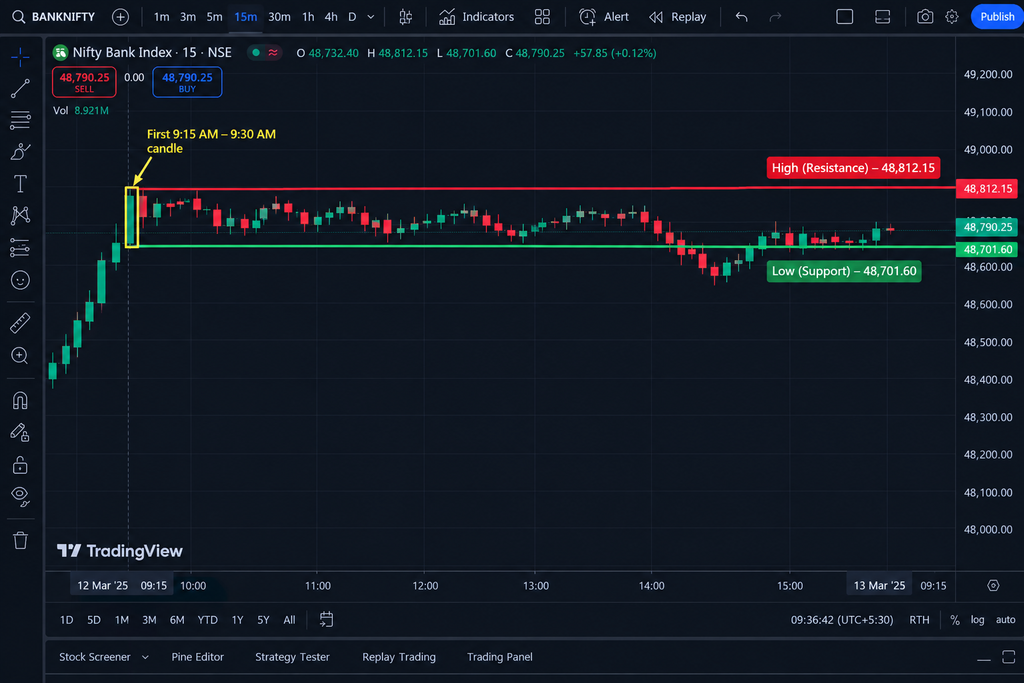
At 9:15 AM IST, the NSE opens. Allow the first 15-minute candle to form completely without placing any trades.
At 9:30 AM, mark the absolute High and Low of that first 15-minute candle on your chart using horizontal lines.
+--------------------------------------------------+
|             First 15-Min Candle Range            |
|                                                  |
|   9:30 AM High  ------------------------------   |
|                 |                            |   |
|                 |   [ 9:15 - 9:30 Candle ]   |   |
|                 |                            |   |
|   9:30 AM Low   ------------------------------   |
+--------------------------------------------------+
This 15-minute range represents the initial balance between institutional buyers and sellers. A breakout above or below this range indicates intraday momentum.
[IMAGE PLACEHOLDER 1: Insert TradingView screenshot showing the First 15-Minute Bank Nifty Candle with High and Low horizontal lines marked at 9:30 AM.]
Exact Entry, Stop-Loss, and Target Rules
Execute trades only when the price breaks out of the initial 15-minute range with strong candle closure.
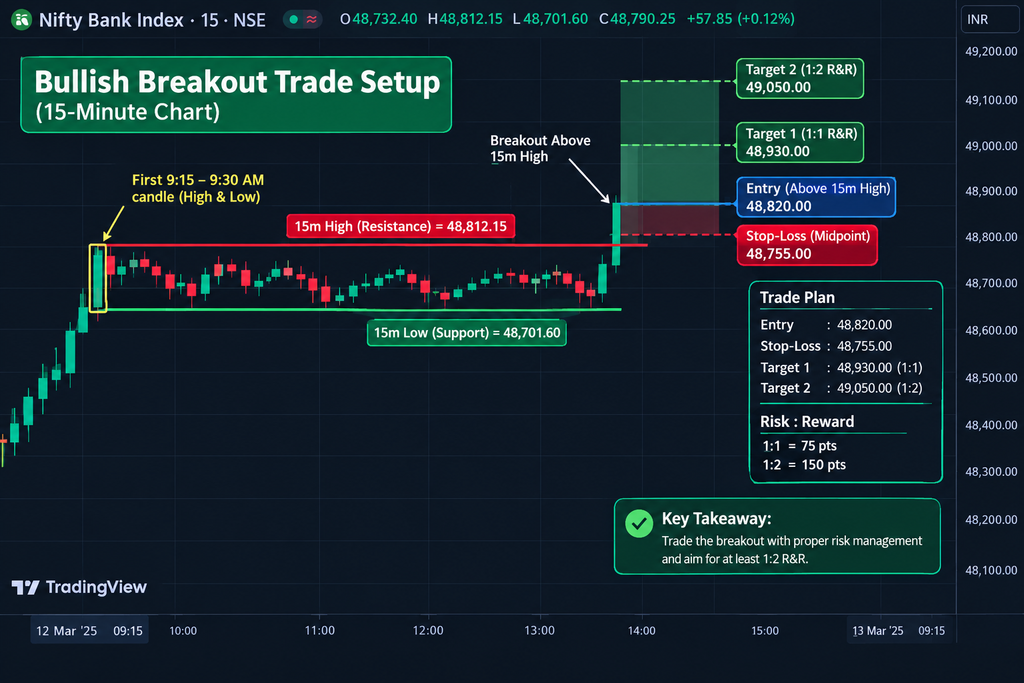
1. Bullish Setup (Buying Call Options – CE)
- Entry Condition: Wait for a 5-minute or 15-minute candle to break and close above the first 15-minute candle’s High. The price should also trade above the VWAP line.
- Strike Price: Select an At-the-Money (ATM) or In-the-Money (ITM) Call Option (CE).
- Stop-Loss (SL): Set the SL for the underlying index at the midpoint of the first 15-minute candle, or 40 points below your entry level in the index. On the option chart, set a hard SL of 15% to 20% of the premium paid.
- Target: Target a 1:2 Risk-to-Reward ratio. If risking 30 points in index terms, aim for a 60-point gain on the index move.
2. Bearish Setup (Buying Put Options – PE)
- Entry Condition: Wait for a candle to break and close below the first 15-minute candle’s Low while trading below the VWAP line.
- Strike Price: Select an At-the-Money (ATM) or In-the-Money (ITM) Put Option (PE).
- Stop-Loss (SL): Set the SL for the index at the midpoint of the first 15-minute candle, or 40 points above your entry level in the index. On the option chart, set a hard SL of 15% to 20% of the premium paid.
- Target: Target a 1:2 Risk-to-Reward ratio. Exit 50% of the position at 1:1.5 and trail the rest using key support levels from our Price Action Support & Resistance Strategy.
- Add Sentence: “When executing this Bank Nifty expiry strategy, entering right after candle closure prevents false breakout losses.”
[IMAGE PLACEHOLDER 2: Insert Infographic showing Bullish (CE) and Bearish (PE) entry points, Stop-Loss placement, and Target projection relative to the 15-minute breakout.]
How to Select the Right Strike Price
Selecting the correct strike price determines your option delta and resistance to Theta decay.
+-----------------------------------------------------------------------+
|                       STRIKE SELECTION MATRIX                         |
+-------------------+--------------------+------------------------------+
| Strike Category   | Delta Range        | Suitability for Strategy     |
+-------------------+--------------------+------------------------------+
| Deep ITM          | 0.70 - 0.90        | Excellent (Moves like Spot)  |
| ATM (At-The-Money)| ~0.50              | Recommended (Best Balance)   |
| Slightly OTM      | 0.30 - 0.40        | Acceptable before 12:00 PM   |
| Deep OTM          | < 0.20             | Avoid (High Risk of Loss)    |
+-------------------+--------------------+------------------------------+
Avoid Deep OTM “Hero-or-Zero” Trades
Retail traders often buy ₹10 or ₹20 Out-of-the-Money (OTM) options hoping for a multi-bagger move. On expiry day, deep OTM options have a Delta close to zero and rapidly lose value. Unless Bank Nifty moves 400–500 points in your direction, deep OTM options generally expire worthless.
Stick to ATM or ITM Options
Focus on At-the-Money (ATM) or slightly In-the-Money (ITM) options:
- ATM Options: Offer a Delta near 0.50, meaning if Bank Nifty moves 100 points, your option premium moves roughly 50 points.
- ITM Options: Have higher Delta (0.60–0.70) and lower time decay relative to intrinsic value, offering movement closer to the spot market.
- Add Sentence: “A critical component of any successful Bank Nifty expiry strategy is choosing At-the-Money (ATM) options over deep Out-of-the-Money options.”
Risk Management Rules for Your Bank Nifty Expiry Strategy
A solid setup requires strict risk management to preserve capital. For a comprehensive breakdown, review our guide on Position Sizing & Risk Management for Intraday Traders.
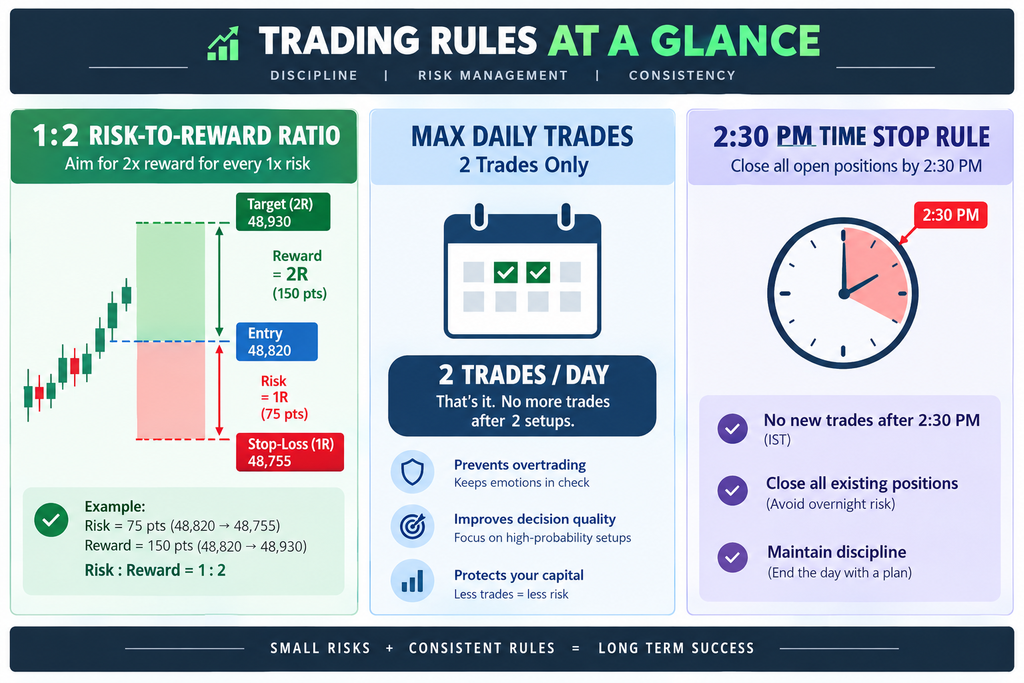
- Maximum 2 Trades Per Day: If your first two trades hit their Stop-Loss, stop trading for the day. Overtrading on expiry day quickly destroys capital through slippage and transaction costs.
- Never Average a Losing Option Position: Buying more contracts as an option premium falls compounds losses. If your stop-loss is triggered, exit the position immediately.
- Use Position Sizing:Risk no more than 1% to 2% of total trading capital on any single trade executed under this Bank Nifty expiry strategy.
- Enforce a 2:30 PM Time Stop: Avoid opening new momentum positions after 2:30 PM. Beyond this time, Gamma risk increases significantly, leading to extreme, unpredictable premium swings that often trigger stop-losses unnecessarily.
- Add Sentence: “Without strict position sizing, even the best Bank Nifty expiry strategy will fail during high-volatility sessions.”
[IMAGE PLACEHOLDER 3: Insert Risk-to-Reward Ratio Diagram showing a 1:2 risk setup with execution boundaries.]
Common Mistakes to Avoid in a Bank Nifty Expiry Strategy
- Trading Before 9:30 AM: Entering positions during the initial 15-minute candle exposes trades to early-morning noise and false breakouts.
- Ignoring the VWAP Indicator: Buying Call options below the VWAP or Put options above the VWAP lowers setup probability.
- Holding Options into Settlement: Expiry option values sink quickly toward the end of the day. Exit positions on your broker terminal before 3:15 PM rather than holding through settlement.
- Failing to Account for Slippage: Fast market moves on expiry day can cause slippage. Use limit orders rather than market orders when buying options to control entry prices.
Conclusion
The Bank Nifty expiry strategy provides a structured frame for capturing directional moves on expiry days. By waiting for the initial 15-minute range to establish, trading in the direction of the breakout with VWAP confirmation, and choosing ATM or ITM strike prices, you position yourself with a systematic edge.
Consistent trading relies on discipline. Protect capital, execute the rules cleanly, and manage risk on every trade. Test this Bank Nifty expiry strategy in a trading journal over 10 to 15 expiry sessions to analyze execution and performance before scaling position sizes. You can also explore our Top Nifty 50 Breakout Strategies to expand your trading playbook.
Add Sentence: “By practicing discipline and tracking your trades in a journal, this 15-minute Bank Nifty expiry strategy can become a consistent part of your weekly trading routine.”
Frequently Asked Questions (FAQ)
1. Which timeframe is best for Bank Nifty expiry trading?
The 15-minute timeframe works well for identifying key support and resistance levels during the opening balance (9:15 AM – 9:30 AM). Once these levels are marked, traders often switch to a 5-minute timeframe to spot earlier breakout closures and refine entries.
2. Can I use this strategy for Nifty 50 expiry day?
Yes, this 15-minute breakout strategy applies to Nifty 50 options as well. Nifty 50 typically exhibits slightly lower volatility than Bank Nifty, so target expectations can be adjusted to a 1:1.5 or 1:2 risk-to-reward ratio based on Nifty’s average daily range.
3. What should I do if the market remains range-bound all day?
If Bank Nifty trades inside the initial 15-minute high and low range without closing outside it, do not execute a trade. A range-bound market causes steady Theta decay that penalizes option buyers. No trade is better than a bad trade.
4. Should I trade option buying or option selling with this setup?
This strategy caters to both styles:
- Option Buyers: Buy ATM/ITM Call options on a high breakout, or Put options on a low breakdown.
- Option Sellers: Sell Out-of-the-Money Put options below the 15-minute low on a bullish breakout, or sell Call options above the 15-minute high on a bearish breakdown to collect time decay.