
Author: Varun Kumar | Blog With Varun
Category: Trading
Reading time: Approximately 12–15 minutes
Introduction
Option Theta Decay is one of the most important concepts every Nifty and Bank Nifty options trader should understand.
Have you ever purchased a Nifty Call or Put option, predicted the market direction correctly, but still ended up losing money?
This situation often occurs because of time decay.
Options are time-sensitive financial instruments. Unlike shares, which do not have a fixed expiry date, exchange-traded options have a specified expiry. As the expiry approaches, the time value of an option generally decreases.
This process is called theta decay.
Understanding theta is particularly important for Indian traders who trade weekly and monthly index options. Even when the market remains sideways, option premiums can decline because of the passage of time.
In this detailed guide, you will learn:
- What theta means in options trading.
- How option time decay works.
- Why theta decay accelerates near expiry.
- How theta affects Nifty and Bank Nifty options.
- How to calculate theoretical theta-related losses and gains.
- How option buyers and sellers experience theta differently.
- How to read theta values in the NSE Option Greeks interface.
- How theta interacts with Delta, Gamma and Vega.
- Seven practical examples with calculations.
All numerical trading examples in this article are hypothetical illustrations, not actual trades or verified backtesting results.
1. What Is Option Theta Decay?

Option Theta Decay refers to the reduction in an option’s theoretical premium due to the passage of time, assuming other pricing variables remain unchanged.
Theta (Θ) is one of the five commonly discussed option Greeks.
It measures how sensitive an option’s theoretical value is to a change in the time remaining until expiry.
In simple language:
Theta tells an options trader how much theoretical premium may be lost or gained as time passes.
For a long option position:
- Theta is generally negative.
- Theoretical option value decreases as time passes.
- Option buyers need sufficient favourable movement or volatility changes to overcome time decay.
For a short option position:
- Theta is generally positive.
- Theoretical option value decreases in favour of the seller.
- The seller may benefit if the option can be repurchased at a lower premium.
Simple example
Suppose you purchase a Nifty 25,000 CE at ₹150.
The option displays a theta value of -5.
Assuming theta is quoted per calendar day and all other pricing variables remain unchanged:
| Particulars | Amount |
|---|---|
| Initial premium | ₹150 |
| Theta | -₹5 |
| Theoretical premium change | -₹5 |
| Theoretical premium after one day | ₹145 |
The estimated reduction is ₹5 per unit.
This does not mean the option must trade at ₹145 the next day. Actual premium movement depends on the underlying index, implied volatility, time, interest rates and market conditions.
2. Understanding Option Premium: Intrinsic Value and Time Value

Before studying theta, you must understand how an option premium is structured.
An option premium consists of two components:
Option Premium = Intrinsic Value + Time Value
What is intrinsic value?
Intrinsic value represents the amount by which an option is in the money.
For a Call option:
Intrinsic Value = Maximum (Spot Price − Strike Price, 0)
For a Put option:
Intrinsic Value = Maximum (Strike Price − Spot Price, 0)
What is time value?
Time value is the portion of the option premium exceeding its intrinsic value.
It represents the value associated with the possibility of favourable movement in the underlying before expiry.
Practical Nifty example
Suppose:
- Nifty spot price: 25,040
- Strike price: 25,000 CE
- Option premium: ₹170
Calculation:
Intrinsic Value = 25,040 − 25,000 = ₹40
Time Value = ₹170 − ₹40 = ₹130
| Premium component | Value |
|---|---|
| Intrinsic value | ₹40 |
| Time value | ₹130 |
| Total premium | ₹170 |
The time value generally decreases as expiry approaches.
However, theta does not directly represent the total reduction in the traded premium. It measures the theoretical sensitivity of the option value to time.
3. How Does Option Theta Decay Work?
Every option contract has a fixed expiry.
As time passes, the remaining opportunity for the underlying to move favourably before expiry becomes smaller.
This affects the theoretical time value of the contract.
Consider a hypothetical Nifty 25,000 ATM Call option.
| Parameter | Value |
|---|---|
| Entry premium | ₹150 |
| Initial theta | -₹5 |
| Holding period | One day |
| Underlying movement | None |
| IV change | None |
The theoretical premium after one day:
₹150 − ₹5 = ₹145
If theta remained unchanged for another day, the theoretical premium would become ₹140.
But there is an important point.
Theta is not constant.
Its value changes with the remaining time, underlying price, strike price and implied volatility.
Therefore, multiplying the current theta by the entire holding period provides only a rough approximation.
4. Why Does Theta Decay Accelerate Near Expiry?
This is one of the most important characteristics of options pricing.
Option time decay is generally nonlinear.
An option with several weeks remaining may experience relatively modest daily decay. As expiry approaches, the time value of an ATM option can decline more rapidly.
The reason is straightforward.
When an option has more time remaining, the underlying has a greater opportunity to make a favourable move before expiry.
When only a few hours or days remain, that opportunity becomes considerably smaller.
Illustrative theta decay table
| Time remaining | General time-decay behaviour |
|---|---|
| 30 days | Relatively gradual |
| 20 days | Time value continues declining |
| 10 days | Greater sensitivity to time |
| 5 days | Decay can become more pronounced |
| 1 day | Particularly sensitive near ATM |
| Expiry | Remaining time value approaches zero at settlement |
These are conceptual stages, not measured theta values or fixed decay rates.
The actual relationship depends on the option’s moneyness, implied volatility and pricing assumptions.
Visual explanation
Imagine a graph with:
- X-axis: Days remaining until expiry.
- Y-axis: Option time value.
The curve generally declines as expiry approaches.
For a suitable ATM example, the curve becomes steeper close to expiry.
The exact curve varies by strike and volatility. Deep ITM and deep OTM contracts can behave differently.
5. Seven Practical Examples of Option Theta Decay
Let’s understand the concept through practical examples relevant to Indian options traders.
All prices, Greeks, quantities and contract values below are hypothetical.
Example 1: Theta Decay in Nifty Call Options
Suppose Nifty is trading at 25,000.
You purchase a 25,000 CE.
Trade details:
| Parameter | Value |
|---|---|
| Instrument | Nifty 25,000 CE |
| Entry premium | ₹150 |
| Theta | -₹5 per day |
| Position | Long Call |
| Holding period | One day |
Assume Nifty remains at 25,000 and implied volatility remains unchanged.
Theoretical premium:
₹150 − ₹5 = ₹145
Theoretical loss:
₹5 per unit.
If the contract quantity is L units:
Theta-related loss = ₹5 × L
For illustration, if L equals 50:
₹5 × 50 = ₹250
The 50-unit quantity is hypothetical, not a statement of the current Nifty lot size.
Lesson: A sideways market can hurt option buyers even without an adverse directional movement.
Example 2: Theta Decay in Nifty Put Options
Theta affects Put options as well.
Suppose:
- Nifty spot: 25,000
- Strike: 25,000 PE
- Entry premium: ₹140
- Theta: -₹4
If Nifty remains unchanged and other pricing variables remain constant:
Theoretical premium after one day:
₹140 − ₹4 = ₹136
Theoretical loss per unit = ₹4.
Both long Call and long Put positions generally experience negative theta.
Example 3: How Option Sellers Benefit from Theta
Now consider a short-option position.
Suppose you sell a hypothetical Nifty Call option.
| Parameter | Value |
|---|---|
| Selling premium | ₹150 |
| Theta of long option | -₹5 |
| Theta exposure of short option | +₹5 |
| Market movement | None |
| Holding period | One day |
If the theoretical premium falls to ₹145, the seller can potentially repurchase the option at that price.
Gross profit:
₹150 − ₹145 = ₹5 per unit.
If the position contains 50 units:
₹5 × 50 = ₹250.
This is a hypothetical calculation.
It excludes brokerage, exchange charges, taxes, slippage and other transaction costs.
More importantly, it assumes that the option can actually be repurchased at the theoretical premium.
Warning: Positive theta does not guarantee profit. A sudden adverse market movement can create losses substantially larger than the accumulated time-decay benefit.
Example 4: ATM vs ITM vs OTM Theta Decay
Theta differs depending on the strike price.
Consider three hypothetical Nifty options with the same expiry.
| Strike category | General characteristic |
|---|---|
| Deep ITM | Larger intrinsic-value component |
| ATM | Often substantial absolute theta exposure |
| OTM | Premium consists primarily of time value |
ATM options often have the highest absolute theta for comparable contracts under similar conditions.
However, percentage decay can be very different.
For example, a ₹10 OTM option losing ₹2 represents a 20% reduction.
An ATM option priced at ₹150 losing ₹5 represents approximately 3.33%.
Therefore, compare both:
- Absolute theta in rupees.
- Theta as a percentage of the option premium.
Do not assume the option with the highest absolute theta necessarily has the highest percentage decay.
Example 5: Intraday Theta Decay
Suppose you purchase a Nifty ATM Call at 10:00 AM.
Your entry premium is ₹120.
The underlying index remains relatively stable until 2:00 PM.
During this period, time continues to pass.
The option’s theoretical time value can decrease.
However, the actual premium movement may also reflect:
- Changes in the Nifty index.
- Changes in implied volatility.
- Gamma effects.
- Bid-ask spread changes.
- Market liquidity.
Therefore, you cannot attribute the entire premium reduction to theta.
Theta is active during market hours, although its impact may be difficult to isolate from other pricing factors.
Example 6: Weekend and Holiday Theta Decay
Does theta decay happen over weekends?
Yes. Calendar time continues to pass when the stock exchange is closed.
However, the exact way weekend time is reflected in the quoted theta depends on the pricing model and whether theta is presented on a calendar-day or trading-day basis.
For example:
- Friday closing premium: ₹100.
- Monday opening premium: ₹94.
It would be incorrect to conclude that the entire ₹6 reduction happened because of theta.
The change could also reflect:
- Global market movements.
- GIFT Nifty developments.
- Changes in implied volatility.
- News events.
- Changes in the underlying index.
Weekend theta is not a fixed percentage of the premium.
Example 7: When Delta and Vega Overcome Theta
This is where many beginners misunderstand option pricing.
Suppose:
- Initial option premium: ₹150.
- Theta: -₹5.
- Delta: 0.50.
- Nifty movement: +30 points.
- Implied volatility remains unchanged.
- Gamma effects are ignored for this simplified approximation.
Estimated delta impact:
0.50 × 30 = ₹15
Estimated theta impact:
-₹5
Approximate combined change:
₹15 − ₹5 = ₹10
Estimated premium:
₹150 + ₹10 = ₹160
This example shows why an option can increase in value despite negative theta.
Now suppose implied volatility also increases.
Vega can contribute an additional positive change.
The actual result depends on all relevant pricing variables, and the simplified calculation should not be treated as an exact option-price forecast.
6. How to Check Theta in the NSE Option Greeks Interface
Indian options traders should learn to interpret the Greeks rather than blindly selecting options based on premium price.
The National Stock Exchange provides an official Option Greeks interface.
Official link: https://www.nseindia.com/market-data/option-greek
Step-by-step process
- Visit the NSE website.
- Open the Option Greeks section.
- Select the relevant underlying instrument.
- Choose the expiry date.
- Select the required strike.
- Examine the Call and Put Greeks.
- Locate the Theta column.
- Compare the values across different strikes.
You should also examine Delta, Gamma and Vega.
Remember that displayed Greeks are model-based estimates. They are not guaranteed future premium movements.
Check the selected contract and data timestamp before making any interpretation.
You can also explore the official NSE Option Chain to examine contract prices, strikes and available market information.
7. How Theta Interacts with Delta, Gamma and Vega
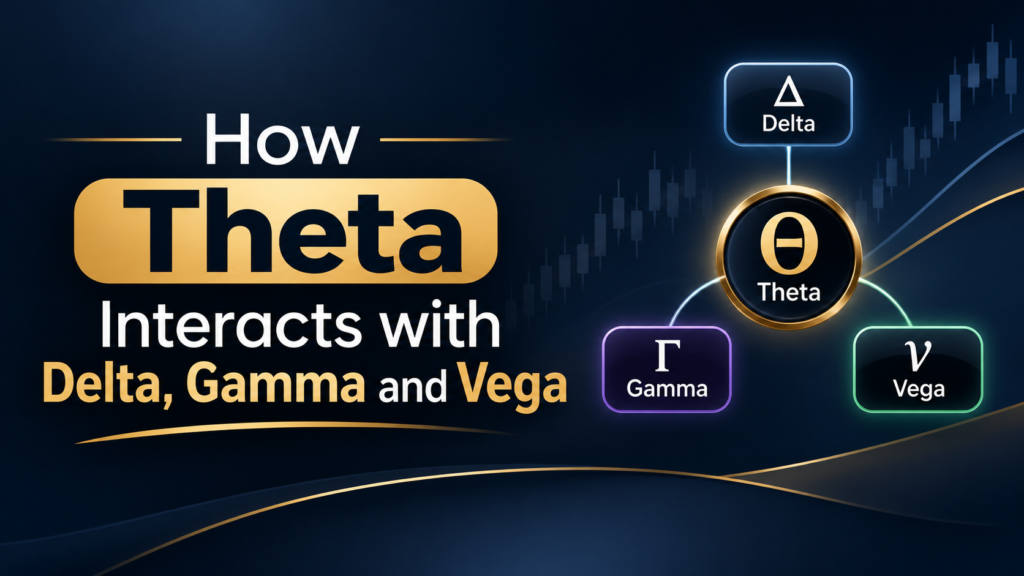
Analysing theta independently is a mistake.
Actual option prices respond to several pricing variables.
Delta
Delta measures the theoretical sensitivity of an option’s price to a movement in the underlying.
For example, a Call option with a Delta of 0.50 may gain approximately ₹0.50 when the underlying rises by one point, assuming other variables remain unchanged.
Gamma
Gamma measures how quickly Delta changes when the underlying price moves.
ATM options close to expiry can have significant Gamma exposure.
This can create rapid premium changes in both directions.
Theta
Theta measures the theoretical sensitivity of an option’s price to the passage of time.
Long options generally have negative theta.
Vega
Vega measures the theoretical sensitivity of an option’s price to changes in implied volatility.
An increase in implied volatility can increase the value of long options, potentially offsetting theta decay.
Comparison table
| Greek | Measures | Important consideration |
|---|---|---|
| Delta | Underlying price sensitivity | Directional exposure |
| Gamma | Change in Delta | Accelerating directional exposure |
| Theta | Time sensitivity | Time-decay exposure |
| Vega | IV sensitivity | Volatility exposure |
A trader should understand how these Greeks interact before entering an options position.
8. How to Use Theta Decay in Nifty and Bank Nifty Trading

Understanding theta can help traders make better decisions about option selection and holding periods.
For option buyers
Before buying Nifty or Bank Nifty options:
- Check the expiry date.
- Examine the current theta.
- Compare ATM and ITM options.
- Check implied volatility.
- Evaluate the expected underlying movement.
- Decide how long you intend to hold the trade.
- Define your maximum acceptable loss.
Buying a cheap deep OTM option simply because the premium looks affordable is not a sound selection process.
The low premium may reflect a low probability of finishing in the money.
For practical execution guidance, read our Bank Nifty Expiry Strategy.
For option sellers
Option sellers may benefit from time decay, but they should also evaluate:
- Gamma exposure.
- Implied volatility.
- Event risk.
- Margin requirements.
- Maximum potential loss.
- Position concentration.
A short option position should not be opened merely because the displayed theta is positive.
Defined-risk spreads can help limit maximum loss, although they introduce their own execution costs and risk characteristics.
9. Common Mistakes Traders Make While Understanding Theta
Mistake 1: Assuming theta is constant
Theta changes as the option approaches expiry.
Do not multiply today’s theta by five days and assume the result is an accurate forecast.
Mistake 2: Ignoring implied volatility
An option’s premium can decline because of falling IV even when the underlying moves favourably.
Mistake 3: Buying options too close to expiry without understanding the risk
Near-expiry options can experience significant time sensitivity and Gamma exposure.
Mistake 4: Believing option sellers always make money
Positive theta does not eliminate the possibility of large losses.
Mistake 5: Ignoring transaction costs
Brokerage, exchange charges, statutory levies and slippage reduce actual trading results.
Mistake 6: Confusing theta with actual premium movement
Theta is a theoretical sensitivity, not a guaranteed daily reduction in the market price.
Mistake 7: Selecting strikes only because their premiums are cheap
Strike selection should consider Delta, theta, IV, liquidity and the underlying market outlook.
10. How to Manage Theta Risk in Options Trading
There is no method that completely eliminates theta exposure from a long option position.
However, traders can manage it through a structured process.
Option buyer checklist
- Select the expiry according to the expected holding period.
- Understand the option’s theta before entry.
- Avoid purchasing options without a directional thesis.
- Evaluate the expected price movement against the premium paid.
- Monitor changes in implied volatility.
- Use predefined exit conditions.
- Calculate position size before entering.
Option seller checklist
- Understand maximum possible loss.
- Avoid excessive naked exposure.
- Monitor Gamma and Delta.
- Evaluate volatility before selling.
- Keep sufficient margin.
- Use defined-risk strategies where appropriate.
- Account for overnight and event risks.
For a more detailed explanation, read our guide on Risk Management in Trading.
You can also study Nifty false breakout patterns to understand why directional assumptions can fail.
11. Theta Decay vs Delta, Gamma and Vega: Key Differences
| Feature | Theta | Delta | Gamma | Vega |
|---|---|---|---|---|
| Main purpose | Time sensitivity | Price sensitivity | Delta sensitivity | Volatility sensitivity |
| Related variable | Time | Underlying | Underlying | Implied volatility |
| Long option exposure | Generally negative | Depends on option | Generally positive | Generally positive |
| Short option exposure | Generally positive | Opposite exposure | Generally negative | Generally negative |
| Near-expiry relevance | High | High | Often especially high ATM | Still relevant |
These Greeks should be studied together.
For additional context on price movement, you can read our RSI Divergence Bank Nifty Options guide and Support and Resistance guide.
12. Important Limitations of Theta Decay
Theta is useful, but it has limitations.
First, it is model-dependent. Different pricing models and time conventions can produce different displayed theta values.
Second, theta changes continuously as the underlying and other pricing variables change.
Third, it does not account for the full realised impact of market gaps, liquidity and execution.
Fourth, a positive theta position can still lose money because of adverse price movements or changes in implied volatility.
Finally, theta does not provide a trading signal by itself.
It should be treated as one component of options risk analysis rather than an independent buy or sell indicator.
Conclusion: Why Understanding Option Theta Decay Matters
Option Theta Decay is a fundamental concept for anyone trading Nifty, Bank Nifty or individual stock options.
The key takeaways are:
- Theta measures the theoretical effect of time on an option’s value.
- Long options generally have negative theta.
- Short options generally have positive theta.
- Time decay is generally nonlinear and becomes more pronounced near expiry for relevant strikes.
- ATM options often have substantial absolute theta exposure.
- Both Call and Put options experience time decay.
- Delta, Gamma and Vega can offset or amplify theta-related premium changes.
- Positive theta does not guarantee profits for option sellers.
Before entering an options trade, examine the expiry, strike price, premium, implied volatility and relevant Greeks.
Most importantly, calculate your risk before selecting your position size.
Understanding theta will not guarantee profits, but ignoring time decay can lead to poor options trading decisions.
Frequently Asked Questions About Option Theta Decay
1. What is Option Theta Decay?
Option Theta Decay is the theoretical reduction in an option’s value caused by the passage of time, assuming other pricing variables remain unchanged. It generally affects long-option positions negatively.
2. Is theta good or bad for option buyers?
Theta is generally unfavourable for option buyers because time decay reduces their option’s theoretical value. A favourable underlying movement or increase in implied volatility may offset this reduction.
3. Which option has the highest theta decay?
ATM options often have the highest absolute theta under comparable conditions, particularly near expiry. However, the exact value depends on the option’s strike, expiry, underlying price and implied volatility.
4. Does theta decay happen during intraday trading?
Yes. Time decay occurs during regular market hours. However, actual option premium changes also depend on Delta, Gamma, Vega and market liquidity.
5. Does theta decay happen on weekends?
Yes. Calendar time continues to pass during weekends and holidays. The way this is reflected in theta depends on the pricing model and whether the platform uses calendar-day or trading-day conventions.
6. Can option sellers make money from theta decay?
Yes, sellers can benefit when the option premium decreases and they close the position at a lower price. However, adverse market movements and volatility changes can create losses that exceed the accumulated theta benefit.
7. How can I check theta in Nifty options?
Visit the official NSE Option Greeks interface, select Nifty and the required expiry and strike, and examine the Theta column. Compare it with Delta, Gamma and Vega before interpreting the option’s pricing exposure.
Financial Risk Disclaimer
This article is published for educational and informational purposes only. It does not constitute investment advice, a recommendation to buy or sell any security, or a personalised trading strategy.
Options and other derivative instruments involve substantial financial risk. Traders may lose some or all of their invested capital. Short-option positions can involve losses substantially exceeding the premium initially received.
Readers should understand the relevant risks, margin requirements, contract specifications and transaction costs before trading. Consult an appropriately qualified financial professional where necessary.
Author: Varun Kumar
Website: Blog With Varun
https://blogwithvarun.com/